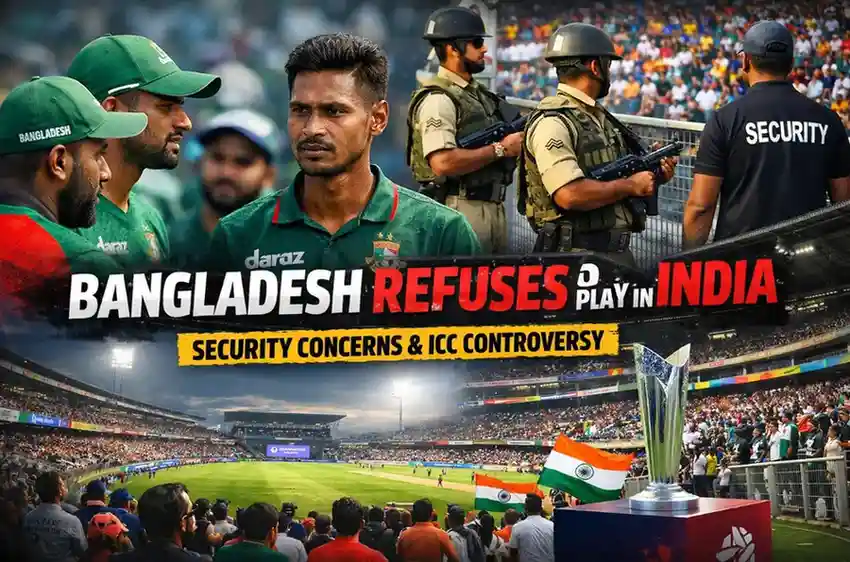
Over the past few weeks, cricket fans across South Asia have been flooded with dramatic headlines claiming that Bangladesh has refused to play in India. Social media debates have been heated, opinions sharply divided, and speculation has often run ahead of facts. However, when you look closely at the developments, this situation is far more layered, human, and complex than a simple “yes or no” refusal.
This is not a political boycott. It is not the end of Bangladesh–India cricket relations. Instead, it is a rare moment where player safety, international governance, commercial pressure, and trust between cricket boards have all collided at once.
This article breaks down the issue calmly and completely—covering security fears, ICC decisions, broadcast realities, IPL complications, and Bangladesh’s internal pressures, while also addressing the gaps many reports failed to explain.
Want to stay conscious about the latest cricket news? Then keep your eyes on the Jeta33 blog section for the latest news of the sports world.
How the Issue Started: A Request That Turned Into a Crisis
The situation began quietly, not with a press conference or protest, but with a formal request. Bangladesh raised concerns about traveling to India for upcoming international commitments, particularly matches connected to ICC events.
At the heart of the matter was a simple but sensitive question:
Can Bangladesh’s players be guaranteed full safety in India during high-profile tournaments?
The request did not ask for cancellation. It asked for clarity—preferably written, enforceable assurances rather than informal promises. When that clarity did not arrive in the form Bangladesh expected, the issue escalated quickly into a public controversy.
Bangladesh Cricket Board’s Position: More Caution Than Confrontation
The Bangladesh Cricket Board (BCB) has been consistent in one message:
This decision is about responsibility, not resistance.
Behind closed doors, the BCB faced several pressures:
- Ensuring player safety in a tense regional climate
- Responding to internal security assessments
- Addressing concerns raised by players and their families
- Avoiding rushed decisions under public pressure
Importantly, the BCB never announced a blanket refusal to play cricket in India. Instead, it chose to pause confirmation until it received clear guarantees. In modern sport, especially cricket, where teams travel with large entourages, such caution is no longer unusual.
What many competitor blogs overlooked is the human side of this decision. Players are not just professionals; they are individuals with families who expect their board to act responsibly.
Security Concerns: Why “Trust Us” Was Not Enough
India has successfully hosted countless international tournaments. That fact is not disputed. However, Bangladesh’s concern was not about India’s capability—it was about process and certainty.
From Bangladesh’s perspective:
- Verbal assurances were insufficient
- Security plans needed to be documented
- Movement protocols required clarity
- ICC-backed oversight was preferred
In an era where international teams increasingly demand detailed risk frameworks, Bangladesh’s request followed a global trend, not an exception.
Many reports mentioned “security concerns” but failed to explain why written guarantees matter. For the BCB, written assurances protect both players and administrators if anything goes wrong.
ICC’s Role: Understanding but Not Accommodating
Once the issue became formal, it landed on the desk of the International Cricket Council (ICC).
The ICC found itself in a difficult position. On one hand, it acknowledged Bangladesh’s concerns and confirmed it was open to discussion. On the other hand, it refused to shift Bangladesh’s matches away from India.
Why?
Because ICC tournaments operate on a rigid structure:
- Venues are finalized years in advance
- Broadcast infrastructure is location-specific
- Sponsors commit based on host-country reach
- Any change sets a precedent affecting future events
The ICC essentially chose institutional stability over accommodation, believing that host-nation security obligations should apply equally to all teams.
India’s Response: “We Are Ready and Capable”
From India’s side, the response was firm but restrained. Officials maintained that:
- India already meets international security standards
- Global teams regularly tour India without issue
- Granting special concessions could undermine host authority
India’s argument was less emotional and more procedural: if one team’s request is accepted, what stops others from doing the same?
This is a point many competitor articles failed to explore. The ICC and India were not dismissing Bangladesh’s fears—they were protecting the structure of international cricket hosting.
The Broadcasting and Commercial Reality Nobody Likes to Talk About
One of the biggest gaps in most coverage is the commercial dimension.
Cricket today is deeply tied to broadcasting. Matches in India generate:
- Massive television audiences
- High-value sponsorship deals
- Advertising contracts locked months ahead
Shifting Bangladesh’s matches would not just affect scheduling—it would disrupt an entire media ecosystem.
This is why the ICC’s refusal was not purely administrative. It was economic. And while fans may dislike that reality, it is impossible to ignore.
IPL Angle: Mustafizur Rahman and Player Release Pressure
The situation became even more complicated due to IPL-related concerns, particularly involving Mustafizur Rahman.
With uncertainty over travel and security:
- Bangladesh hesitated to release players
- Franchises faced planning difficulties
- Media speculation added unnecessary drama
Although the BCB clarified that IPL participation was not the central issue, the overlap intensified pressure from broadcasters, franchises, and fans.
This crossover between national duty and franchise cricket is a modern challenge that competitor blogs mentioned but did not fully explain.
What This Is NOT: Clearing the Noise
Let’s be clear about what this situation is not:
- ❌ Not a political protest
- ❌ Not a permanent refusal to play India
- ❌ Not a breakdown of cricket relations
- ❌ Not a withdrawal from ICC events
It is a temporary deadlock, driven by caution, communication gaps, and structural limitations.
Public Reaction: Fans, Experts, and Former Players
Reactions across the cricketing world have been mixed:
- Some former players backed Bangladesh’s caution
- Others felt the ICC should not bend rules
- Fans largely expressed frustration at uncertainty
What united most voices, however, was the belief that this should never become a public war of words.
Cricket thrives when disputes are solved quietly, not through leaks and headlines.
What Happens Next?
As things stand:
- Bangladesh has not issued a withdrawal notice
- The ICC has not changed venues
- Discussions are ongoing behind the scenes
Possible outcomes include:
- Enhanced security documentation
- ICC-monitored safety arrangements
- A face-saving compromise acceptable to all sides
A complete breakdown remains unlikely.
Bigger Picture: What This Means for International Cricket
This episode exposes a deeper truth about modern cricket:
- Player welfare is gaining power
- Boards are becoming more cautious
- Commercial interests shape decisions more than ever
In the future, we may see standardized security guarantees becoming mandatory for all ICC events—something Bangladesh’s stance may quietly accelerate.
Final Thoughts
Bangladesh’s refusal to play in India, as portrayed by headlines, is an oversimplification. The reality is a careful, sometimes uncomfortable negotiation between safety, trust, governance, and money.
This is not about fear or defiance. It is about responsibility in a sport that has grown too big to rely on assumptions alone.
If handled wisely, this episode could strengthen international cricket rather than divide it—by making transparency and player welfare central, not optional.
👉 Stay updated with cricket discussions, match insights, and responsible sports engagement by visiting jeta33 casino and exploring its cricket-focused sections.
Cricket will move forward. The only question is how carefully it chooses to do so.